Audrey Sze shares her benefits story and reflects on Pinterest’s support during her recovery after cochlear implant surgery.
Hi Audrey! Thanks for joining us to share your benefits story. How long have you been at Pinterest?
I’ve been at Pinterest since 2020, about five and a half years now! I’m based in the San Francisco Bay Area and currently hold dual roles: I’m the Chief of Staff to our VP of Support Operations; I also lead our Support Strategy & Product Operations team. This is a fairly recent move for me as an internal transfer, so I’m kind of on my “second life” at Pinterest. I spent my first five years here on the Business Operations team where I got to work on building our thriving Creator and content ecosystem. These days, I’m improving our support experience for all Pinterest customers!
You shared that you had a major procedure to receive a cochlear implant to improve hearing in your left ear. Can you describe your experience deciding to undergo surgery and planning for it?
I’ve been hard of hearing my whole life. I did not learn sign language growing up and was raised identifying as somebody who belonged to the hearing community. I just assumed that everyone had difficulty keeping up with conversations: I got really good at pretending I knew what was going on.
It wasn’t until I started working that I began to understand that hearing was a spectrum. While I didn’t fully identify with the Deaf community, I also have never truly been fully part of the hearing community. Like many hard of hearing folks in this ”in-between” space, I started wearing hearing aids about eight years ago to help with sound amplification and this meaningfully accelerated my career. (My health benefits in tech helped me afford them!)
Two years ago, I underwent testing again and my audiologist informed me that my lack of hearing and language comprehension in my left ear was severe enough that I qualified for a cochlear implant. This technology was the only way that I could gain better hearing in my left ear, but it would require an invasive head/ear procedure and at least a year of rehab to re-learn how to hear.
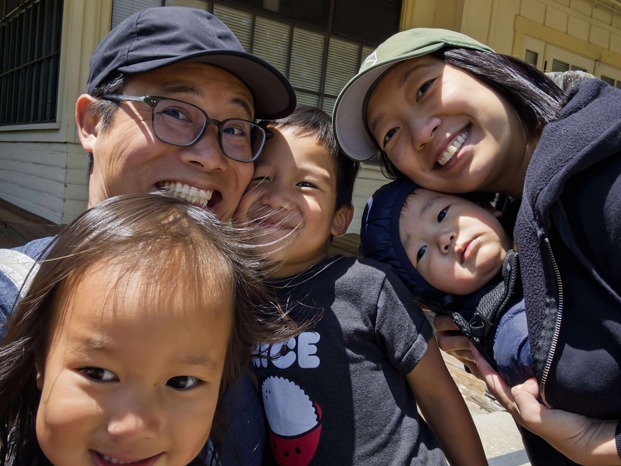
While this all sounded absolutely terrifying, I realized that in order to have the best possible relationship with my kids, I’d need to be able to understand them better. Eventually, I was an enthusiastic yes to try something new that could significantly improve my quality of life.
The actual decision to go through with the surgery all came together very quickly. I was literally at Disneyland with my family when I got the call that my surgeon’s schedule had unexpectedly opened up. I ended up having surgery two weeks later on my wedding anniversary!
How did Pinterest support you during the surgery and recovery process?
While I knew the recovery time would require me to take time away from my job, I never had to worry about whether Pinterest would support my decision. I mapped out a coverage plan and my team helped cover my responsibilities during the four weeks I needed for recovery.
The actual recovery, however, was really tough. I felt like I was in a tin can underwater for most of those four weeks. The fluid in my ear left me unbalanced and dizzy for much longer than I expected. At one point, I was unsure if I needed to extend my leave. My team was very supportive of that possibility. Ultimately, I didn’t need it, but knowing I had that option was a big relief.
Was there anything you learned throughout the process that surprised you?
Absolutely - a ton of things!
- Re-learning how to hear with an electric signal was a wacky experience. The first few weeks, everything sounded like robots warbling!
- Cochlear implant technology may challenge conventional definitions of sound — when I stream something via Bluetooth to my implant, I “hear” the sound via electric signals that register as “sound” to my brain, but nobody else in the world can hear it!
- I’ve been so delighted being able to access sounds I’ve never heard before: the cute little whir of my label maker, actually being able to hear my youngest kid crying in the nursery, proudly declaring to my husband I discovered a leaky faucet (to which he replied that we’ve had a leaky faucet for over a year).
How was your transition back into your full-time role after recovery? And how did your manager or team assist you during your return?
Upon my return, my team and cross-functional stakeholders were all very accommodating of the small adjustments I had to make in my day-to-day work.
I let people know that I might need them to repeat themselves more often in meetings. I also shifted all my meetings to video calls when possible: having the ability to turn on closed captioning, transcripts and recordings helped to maximize my comprehension.
These habits are now natural parts of how I work and I’m glad that that rehab period really pushed me to get more comfortable advocating for myself.
You’re also a member of Pinterest’s PinAble Pinclusion Group. Can you share more about this community?
PinAble is one of my favorite ERGs at Pinterest! We are a small but mighty community. There is deep cognitive empathy across our members and folks are very leaned in. We have a lot of great programming: fireside chats with renowned disability advocates, speakers on neurodiversity and mental health in the workplace, and interactive activities like junk journaling and cooking classes. Not only do I feel seen here, I’ve made some really wonderful connections across the company because of PinAble.
Thanks to Pinterest’s leave benefits and supportive work environment, I’m truly able to live the life I love. Gaining vastly improved hearing and comprehension has helped my self confidence and my sense of belonging. I’m so glad Pinterest enabled me to take that leap of faith on a cochlear implant so I could experience a life full of sound!
Our goal is to create a safe, comfortable, and productive work environment for our team, where all employees feel supported and set up for success at Pinterest. We have a Workplace Accommodations process for our employees and this support extends to our applicants as well; if you require medical or religious accommodation during the job application process, please complete this form.


